The strongest alignment between media presence and election results can be seen at the top. Gibanje Svoboda and SDS were by far the most present in the media, and at the same time also the most successful in the elections. The comparison shows that high media exposure translated into election results for both of them. When a party consistently occupies a large share of media space over a longer period, it generally builds recognition, reinforces key issues, and maintains a high degree of political relevance.
The greatest deviation can be seen in Levica + Vesna, which achieved 10.98% of total media presence over the entire period, but won 5.58% in the elections. This is the clearest example of a mismatch between media visibility and actual voter support.
On the other hand, Resni.ca shows the reverse relationship. Over the full period, it achieved 4.08% of total media presence, but received 5.52% in the elections. This example shows that even a smaller media presence can translate into a relatively good election result.
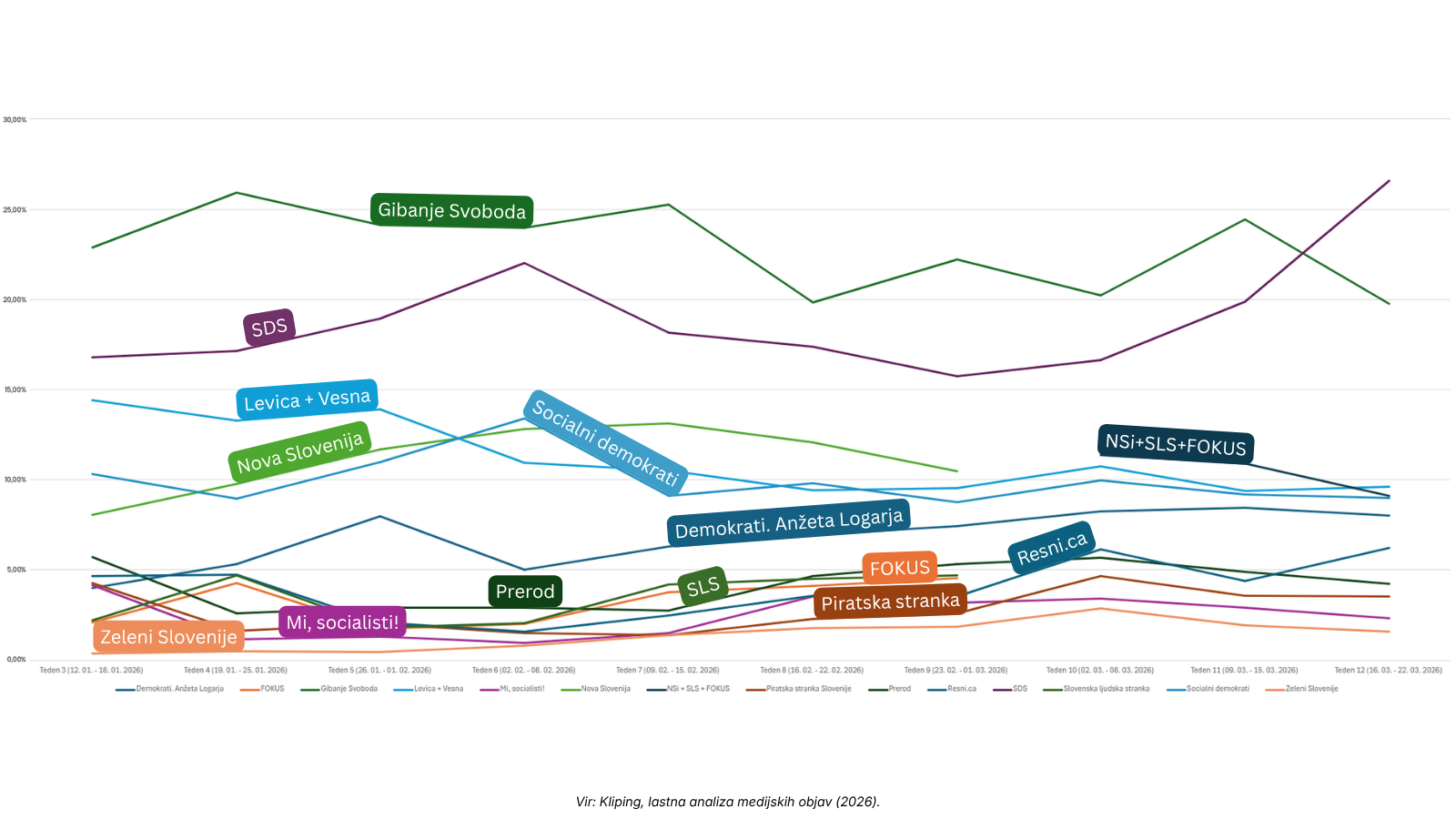
An interesting insight also comes from comparing different time periods. The results calculated on the basis of the full monitoring period were the closest to the actual election outcome. If we compare the full period, the last month, and the final week of the campaign, the full period and the last month most closely matched the real picture, as both correctly identified the three strongest political blocs: Gibanje Svoboda, SDS, and NSi–SLS–Fokus. The final week was less accurate because it reflected the campaign’s media finish more strongly; during that time, SDS jumped into first place in terms of media presence. Among the individual weeks, the picture in the sixth week of monitoring (February 2–8) came closest to the final electoral ranking, when the order of parties almost completely matched the final result, with only minor deviation in the middle of the table.
This suggests that longer-term media presence is generally more informative for assessing final political strength, while the final week mainly reflects the intensity of the campaign’s closing phase.
.png)
The overall media result across the full monitoring period is also telling. Of the first nine parties ranked by share of media presence, eight also crossed the parliamentary threshold. The only exception was the party Prerod, which did not convert its media presence into an electoral result. It is also worth highlighting that its media presence had already been declining in the final two weeks of monitoring.
The main conclusion is clear: media presence is not the same as electoral success, but it is a reliable indicator of political relevance and the balance of power within a campaign. That is precisely why analyses of this kind provide valuable insight into political communication and the influence of media presence on public perception of individual actors.
For additional information or the full media analysis, please write to us at info@kliping.si.